TALES FROM LUBEC
Episode One: THE FIRST LIGHT

TALES FROM LUBEC
Episode One
Copyright © 2026 Steve Porter
All rights reserved.
THE FIRST LIGHT
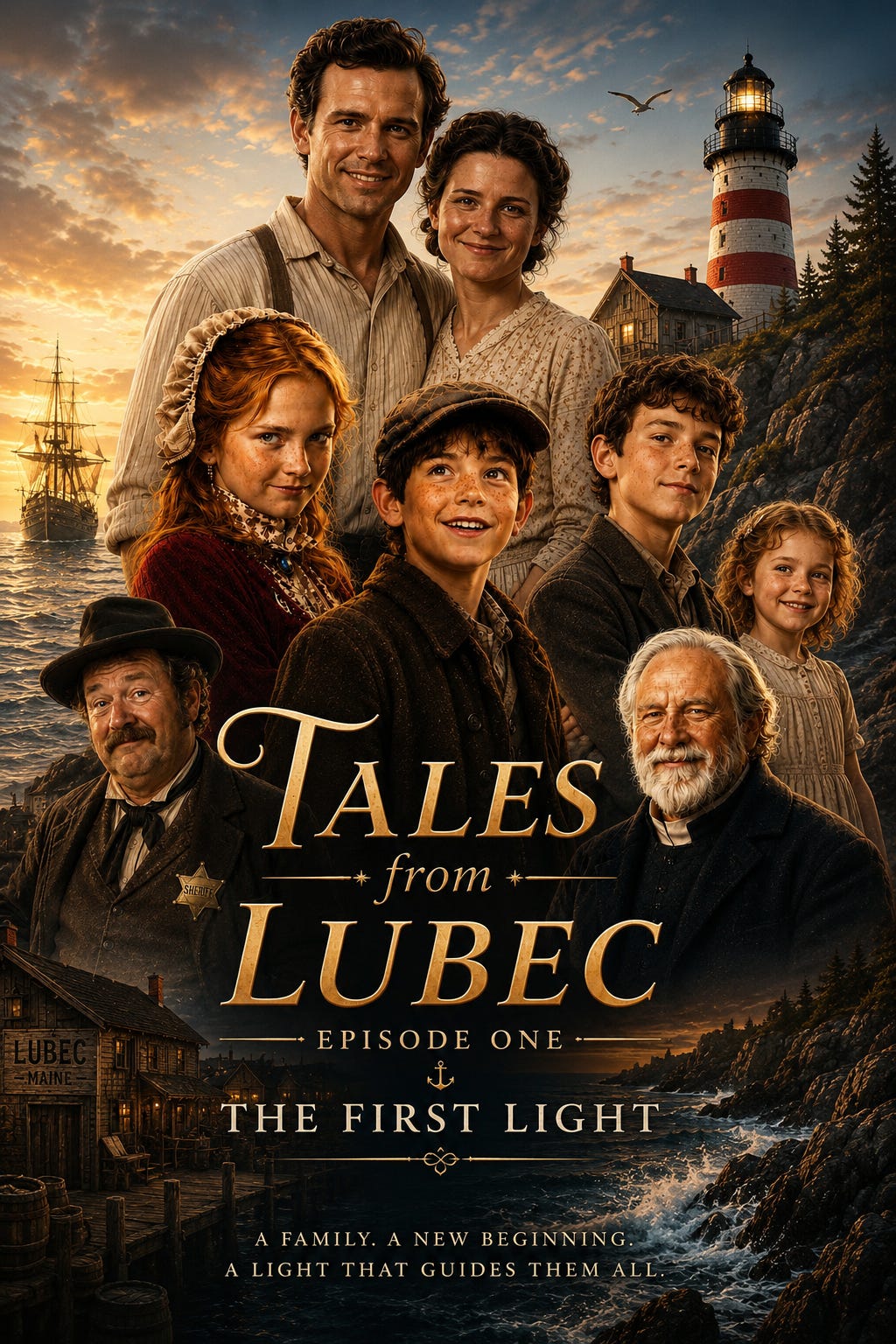
Autumn, 1808
In 1808, the land that would one day become the state of Maine still belonged to Massachusetts. Far to the northeast, near the rocky edge of America itself, sat the small coastal settlement of Lubec. It was a rough and weathered place where fog rolled thick over the Atlantic waters, fishermen rose before dawn, and lantern light glowed warmly through windows during long coastal nights.
And in the autumn of that year, the people of Lubec waited eagerly for something new.
A lighthouse.
The wagon wheels groaned softly as they rolled over the rough coastal road.
Cold wind moved through the pine trees, carrying with it the smell of saltwater somewhere ahead.
Wayne Hale stood on the back step of the wagon despite being told at least six times to sit down properly.
“Wayne,” Laura Hale called gently, pulling her shawl tighter around herself. “If you fall off this wagon after all these miles, your father may leave you beside the road.”
“I’d catch up,” Wayne answered confidently.
Austin chuckled from beside a stack of crates.
“You’d cry before supper.”
“I would not.”
“You cried when that goose chased you.”
“That goose was possessed.”
Laura covered a laugh with her hand while little Carol Ann giggled beneath a wool blanket.
David Hale shook his head from the front seat but a small smile pulled at the corner of his mouth.
The road narrowed as the wagon climbed between heavy pine woods. Fallen leaves scattered across the path in shades of gold and rust. Their old bay horse snorted clouds into the cold air.
The Hale family had been traveling for days.
Not in one of the large prairie wagons people imagined years later, but in a heavy coastal freight wagon built for rough New England roads. Dark wood sides creaked beneath tied barrels, sea chests, blankets, cookware, lanterns, tools, and all the small pieces of a family beginning again.
An oilcloth covering had been stretched carefully over part of the wagon to protect supplies from rain and sea mist.
Everything they owned rattled with every rut in the road.
And still… David felt lighter than he had in years.
Boston had never truly felt like home to him.
He had grown up farther north along the Massachusetts coast in a smaller fishing town where boys learned early how to mend nets, split wood, respect elders, and fear God. His father had been a hard-working ship carpenter with rough hands and simple wisdom.
“An honest man sleeps better than a rich one,” his father often said.
David had carried those words his entire life.
But Boston had changed quickly over the years. The docks grew crowded. Streets grew noisy. Rough men wandered the waterfront late into the night. David worked honestly near the shipping yards, but more and more he found himself longing for quieter shores.
Then he met Laura.
She had been raised in the city, though not by its worst parts. There was gentleness in her from the beginning. While others chased status and appearances, Laura carried sincerity. She worked hard. Cared deeply. Loved Scripture. And when David first saw her helping an elderly woman carry groceries through winter slush outside the market district, something in him settled immediately.
He married her two years later.
Then came the children.
And with the children came worry.
Not fear for himself.
Fear for what the city might slowly shape them into.
Wayne had already begun picking up foolishness from rough boys near the docks. Austin had become restless and sharp-tongued at times. David saw the direction things could go if he stayed too long.
Then one evening, after hearing word that a new lighthouse keeper was needed in Lubec, he sat quietly at the supper table long after the children had gone to bed.
“I think we should go,” he finally told Laura.
“To Lubec?”
“Yes.”
“That’s nearly the edge of the world.”
David smiled faintly.
“Maybe that’s exactly why I want it.”
Laura had looked down at her hands for a long moment.
Then softly she asked:
“Do you believe it would be good for the children?”
“I do.”
And that had settled it.
Now here they were.
Somewhere between the life they had known…
and the one waiting ahead.
By late afternoon the sky turned gray.
The road became rougher as they pushed farther northeast. Wind rattled the pine branches overhead.
“We stopping soon?” Austin asked.
“When your father finds a decent place,” Laura answered.
“I’d settle for a bad place,” Wayne muttered.
“You’d settle for food,” Austin corrected.
“That too.”
David finally guided the wagon into a small clearing near the trees where a brook moved quietly over rocks.
The family climbed down stiffly.
Laura immediately began preparing supper while Austin gathered wood.
Wayne was told one simple task.
“Hang the food satchel high tonight,” David instructed. “Far from camp.”
“I know.”
“You said that yesterday too.”
Wayne grabbed the satchel dramatically.
“Yes sir, Captain of Bears.”
Austin laughed.
But later, after supper, Wayne became distracted skipping stones near the brook with Carol Ann and forgot entirely.
The satchel remained hanging low beside the wagon.
The night grew cold quickly.
By the time everyone settled beneath blankets near the fire, fog had begun creeping between the trees.
For a while there was only the crackling firewood, the distant wind, and the steady sound of the brook.
Then came the noise.
A low grunt.
Austin sat upright instantly.
The horse jerked nervously against its lead rope.
Another grunt came from the darkness.
Closer.
Laura pulled Carol Ann toward her.
Wayne’s stomach dropped.
“Oh no.”
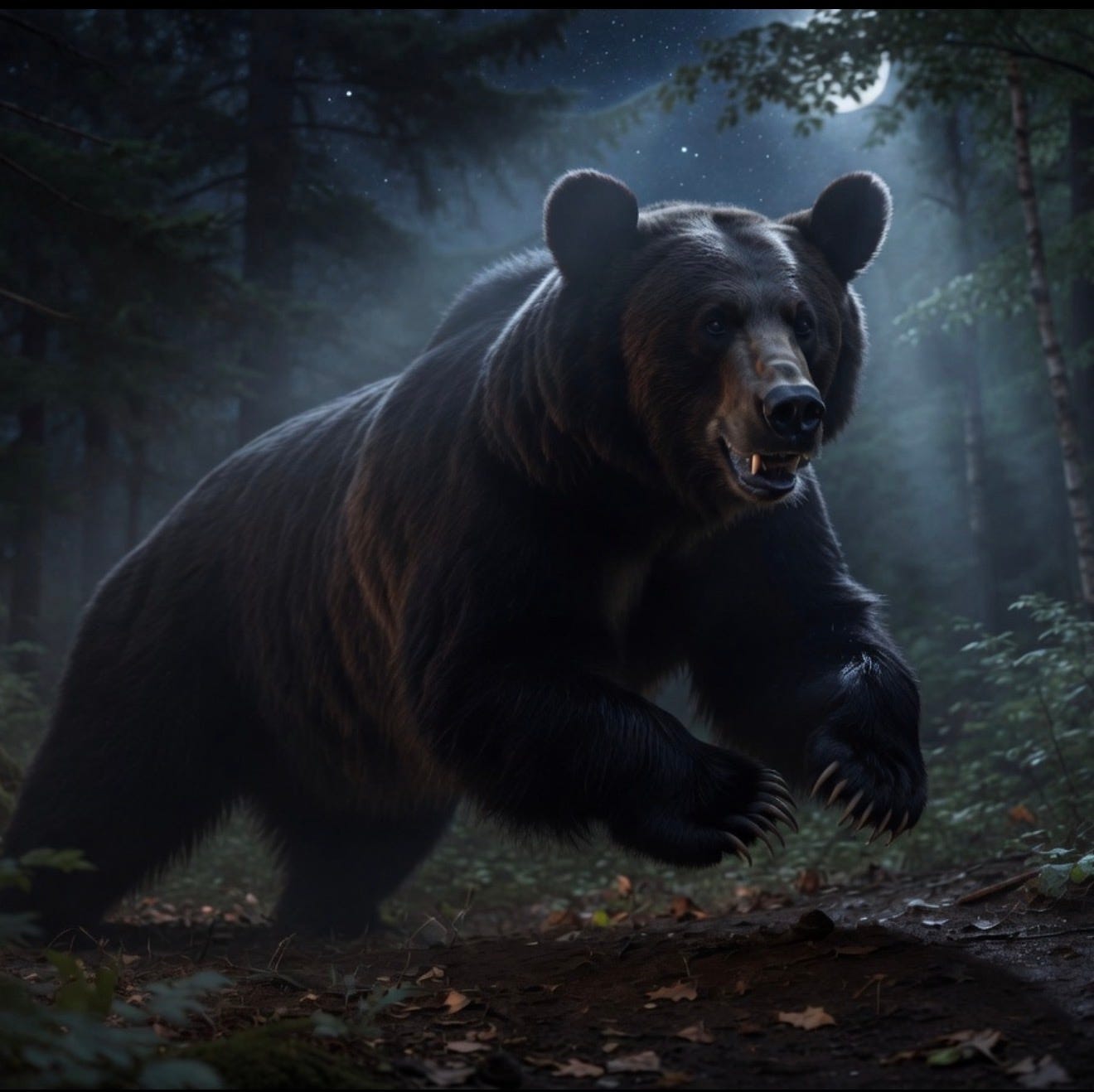
A large black bear emerged slowly near the wagon, nose lifted toward the food.
For one terrible second nobody moved.
Then the bear shoved against a crate, sending a pan crashing onto the ground.
The horse reared violently.
Carol Ann screamed.
David was already moving.
He grabbed the long rifle near the wagon wheel and stepped forward between the animal and his family.
“Back!” he shouted.
The bear rose partly upward with a deep growl.
Wayne froze.
His father stood firm.
Not reckless.
Not wild.
Just steady.
The firelight flickered across David’s face as he raised the rifle.
The shot thundered through the trees.
Birds burst upward into darkness.
The bear stumbled, crashed through brush, and disappeared into the woods.
Then silence.
Only the horse breathing hard.
Only Carol Ann crying softly.
Only Wayne staring at the ground.
David lowered the rifle slowly.
Then he looked directly at Wayne.
Not angry.
That somehow made it worse.
“You forgot the satchel.”
Wayne swallowed hard.
“Yes sir.”
For a moment David said nothing.
Then he walked over, rested a rough hand briefly on Wayne’s shoulder, and said quietly:
“A careless mistake can grow teeth in the wilderness.”
Wayne nodded, ashamed.
But later that night, long after everyone settled down again, Wayne woke briefly and saw his father still sitting awake beside the fire with the rifle resting across his knees.
Watching.
Protecting.
And something about that stayed with him.
Three days later they reached Lubec.
The first thing Wayne noticed was the sea.
Not Boston harbor crowded with ships and shouting men.
This felt different.
Wild.
The Atlantic stretched gray-blue beneath the autumn sky while waves crashed against dark rocks below high cliffs. Gulls wheeled overhead crying into the wind.
Fog drifted low over the distant water.
Small homes sat scattered along muddy roads. Smoke rose from chimneys. Fishing nets hung drying beside sheds weathered by salt and storms.
Men in wool coats unloaded barrels near rough docks.
Children ran laughing between buildings.
Pine smoke drifted between the buildings while the scent of salt air and fresh fish rolled in from the docks.
And somehow…
It already felt like a place with stories inside it.
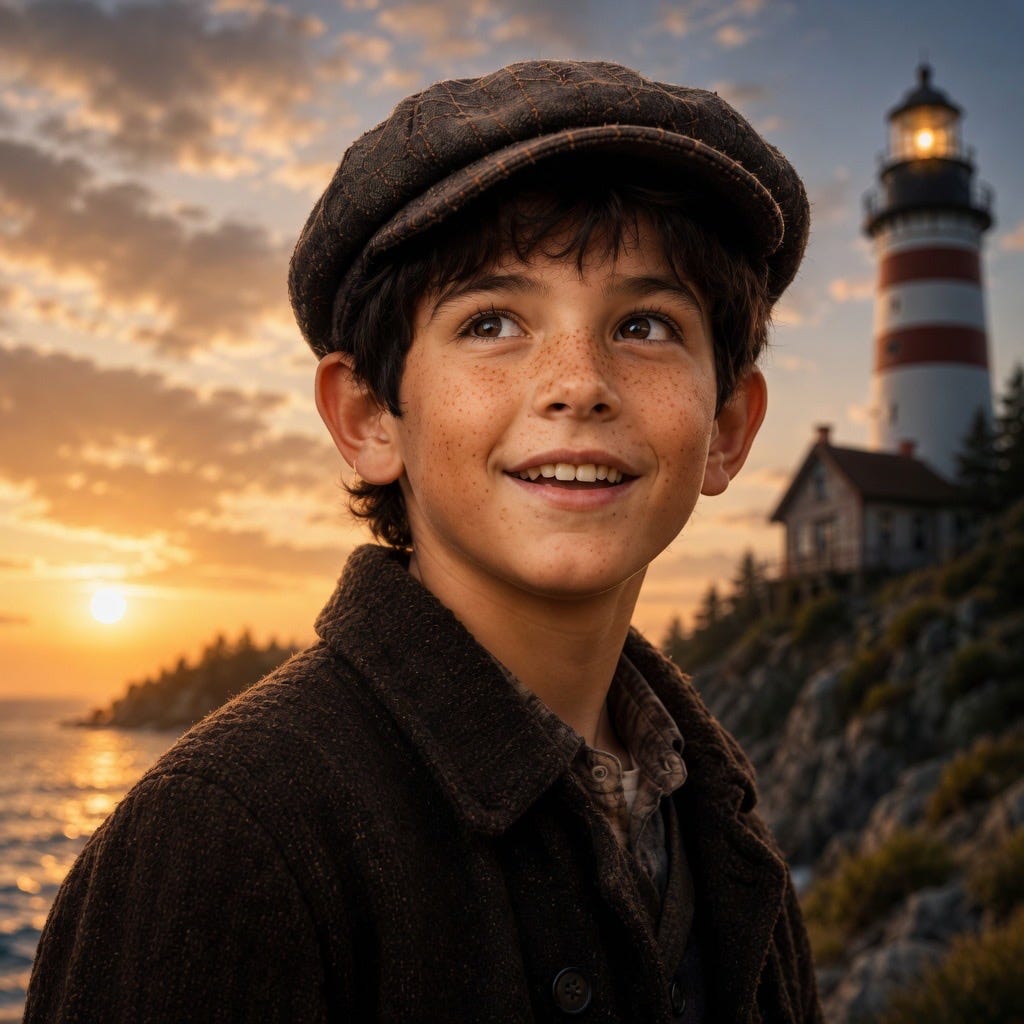
Wayne stared wide-eyed from the wagon.
“It’s beautiful,” Laura whispered softly.
David nodded.
“Yes,” he answered quietly. “It is.”
Then Wayne saw it.
Farther out along the rocky point stood the new lighthouse.
Fresh timber still pale from construction rose above the cliffs. Workers moved around the structure carrying tools and lumber while lantern glass near the top caught the fading afternoon light.
Wayne nearly climbed out of the wagon.
“Is that it?”
“That’s it,” David answered.
“Our lighthouse?”
David smiled slightly.
“Our lighthouse.”
Even Austin looked impressed.
Carol Ann clapped excitedly beneath her blanket.
The wagon rolled slowly through town toward Quoddy Head.
People glanced curiously at the newcomers.
Then suddenly a loud voice shouted behind them.
“Hold! HOLD THERE!”
Everyone turned.
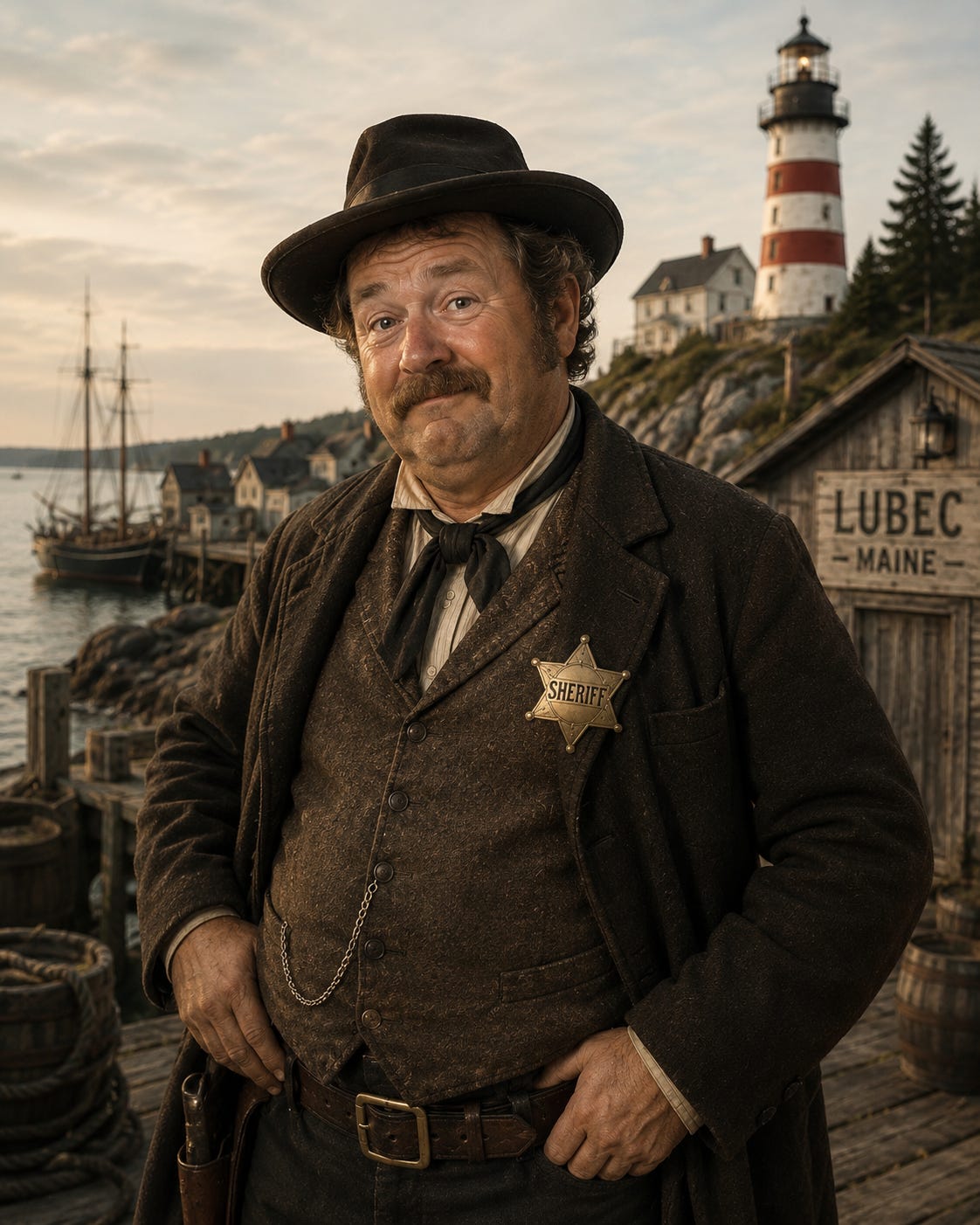
A heavyset man in an oversized coat came hurrying through the mud waving one arm wildly while trying not to lose his hat in the wind.
Unfortunately he failed at both.
His hat flew directly into a puddle.
The man lunged for it, slipped halfway sideways, caught himself on the wagon, then attempted to recover with dignity he no longer possessed.
“I meant to do that,” he announced breathlessly.
Wayne bit his lip hard to avoid laughing.
The man straightened proudly.
“Deputy Sheriff Caleb Boone,” he declared. “County law enforcement.”
A chicken suddenly darted between his legs.
Boone yelped and stumbled backward into a crate.
Three cooking pans crashed loudly into the mud.
Laura looked down to hide a smile.
David climbed down politely.
“David Hale. We’re the new lighthouse family.”
“Yes yes, of course,” Boone said quickly while trying to wipe mud from his coat unsuccessfully. “Very important position. Lighthouse business. Safety matters and such.”
He leaned closer dramatically.
“Lot of suspicious things happen near water.”
“Like chickens?” Austin asked.
Boone narrowed his eyes.
“Especially chickens.”
Wayne nearly choked holding in laughter.
After several more minutes of Boone explaining matters nobody had asked about, David finally guided the wagon onward.
As they pulled away, Wayne glanced back.
Boone was still talking.
To no one.
Not long afterward David realized they lacked several supplies for the coming week.
“I need flour, lamp oil, and salt pork,” Laura said while checking their crates.
“I’ll take the wagon,” Austin offered.
“I’m coming too,” Wayne announced immediately.
“You’re always coming too,” Austin muttered.
The mercantile sat near the center of town beside stacked barrels and fishing crates.
A wooden sign overhead read:
GRANGER MERCANTILE
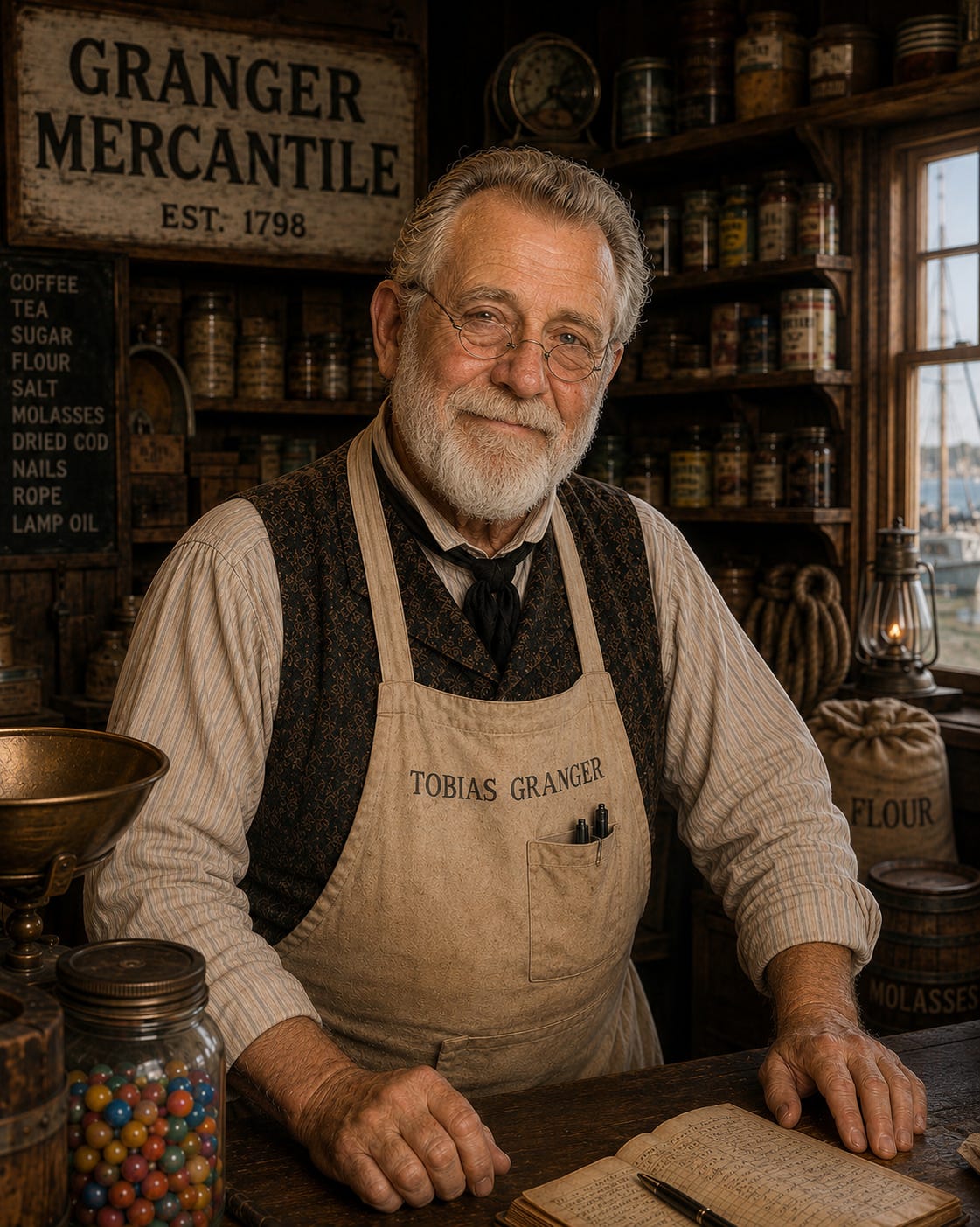
The moment Wayne stepped inside, his eyes widened.
The store smelled of coffee beans, leather, cedar, tobacco, and spice.
Shelves stretched upward packed with lanterns, ropes, boots, bolts of fabric, jars of candy, fishing hooks, nails, tools, and a hundred other things Wayne could not even name.
A barrel near the stove held peppermint sticks.
Wayne stared at them like treasure.
Behind the counter stood a broad older man with suspenders and sharp eyes full of humor.
He studied Wayne silently for several seconds.
Wayne immediately tried standing taller.
The man nodded slowly.
“Well now,” he said. “Who’s this little fellow marching around like he owns the lighthouse already?”
Austin groaned softly.
Wayne folded his arms importantly.
“My father’s the new keeper.”
“Is that so?”
“Yes sir.”
The man grinned.
“Well then…”
He pointed directly at Wayne.
“The General.”
Wayne blinked.
“The what?”
“The General,” the man repeated. “You’ve got the posture for it already.”
Austin smirked.
Wayne tried looking offended but secretly loved it.
The man extended his hand.
“Tobias Granger.”
Wayne shook it proudly.
And somehow, standing there among lanterns, candy jars, sea ropes, and the smell of cedarwood near the edge of America itself…
it felt like something new had finally begun.
Tobias Granger leaned both hands against the counter and looked Wayne over once more.
“Well, General,” he said, “if you’re planning on commanding the whole coastline, you’ll at least need proper supplies.”
Wayne straightened proudly.
“Yes sir.”
Austin rolled his eyes.
“He’s been commanding things since Boston.”
“That’s because nobody else around here knows what they’re doing,” Wayne answered.
Tobias barked out a laugh so suddenly that even the old hound sleeping beside the stove lifted its head.
“Oh, I like this one already,” Tobias said.
He reached beneath the counter and slid a small striped peppermint stick toward Wayne.
“For the long journey.”
Wayne stared at it a moment.
Not because he had never seen candy before.
But because the gesture felt warm.
Like the town itself had just shaken his hand.
“Thank you,” Wayne said quietly.
Austin was already gathering flour, salt pork, lamp oil, oats, coffee, and dried beans while Tobias wrapped the supplies neatly in brown paper and tied each parcel carefully with twine.
A few townspeople wandered through the mercantile while they worked.
An older fisherman nodded politely toward the boys.
“You the lighthouse keeper’s sons?”
“Yes sir,” Austin answered.
The fisherman glanced toward Wayne.
“That one yours too?”
“Unfortunately,” Austin muttered.
Wayne shoved him.
The fisherman chuckled softly beneath his gray beard.
“Well… folks are excited about that lighthouse. Waters out here can turn ugly fast when fog rolls in.”
Tobias grunted agreement.
“Lost enough ships already.”
For a moment the store grew quieter.
Even Wayne could feel something heavy beneath the words.
The sea around Lubec was beautiful.
But it was not gentle.
That lighthouse meant something to these people.
Real safety.
Real hope.
Wayne glanced out the mercantile window toward the distant cliffs.
He could barely see the top of the new tower from town.
Something stirred inside him.
Not pride exactly.
Something deeper.
Like his family had somehow become part of something important.
“You boys heading back up to Quoddy Head now?” Tobias asked.
Austin nodded.
“Father wants the wagon back before dark.”
“Well then,” Tobias said, handing over the final wrapped parcel, “best not keep your mother waiting. Women get dangerous when supper’s late.”
“That’s true,” Wayne agreed seriously.
Austin chuckled.
“You nearly got eaten by a bear yesterday.”
“That bear was unreasonable.”
Tobias laughed again.
“Oh, Lubec’s going to enjoy you, General.”
The boys carried the supplies outside where cold wind swept through the muddy street.
The wagon waited beside the hitching rail.
Wayne climbed up first while Austin loaded the back carefully.
From farther down the road came the unmistakable sound of Deputy Sheriff Boone arguing loudly with someone about a missing chicken.
“I’m telling you,” Boone declared dramatically, “that bird had suspicious intentions.”
Wayne burst into laughter so hard he nearly dropped the flour sack.
Even Austin smiled.
The horse started forward slowly as they left the center of town behind.
The farther they traveled toward Quoddy Head, the quieter everything became.
The muddy road narrowed near the cliffs.
Pine trees bent in the ocean wind. Gull cries echoed overhead while waves crashed somewhere below the rocks beyond sight.
The air smelled stronger now.
Saltier.
Cleaner somehow.
Wayne rested both arms along the front of the wagon seat and stared ahead.
Far in the distance, the lighthouse rose above the dark shoreline.
New timber still pale beneath the fading light.
Workers moved like small shadows around its base while the lantern room high above reflected streaks of evening sun.
“It’s bigger up close,” Wayne whispered.
Austin nodded quietly.
For once, they both seemed unsure what to say.
As they rounded another bend in the road, the sea suddenly opened wide beside them.
Wayne sucked in a breath.
The Atlantic stretched endlessly beneath the autumn sky, rolling dark blue and silver beneath drifting fog. Waves crashed against jagged rocks below the cliffs with thunder that seemed to shake the earth itself.
Neither boy spoke for several seconds.
Back in Boston, the harbor had always felt crowded.
Busy.
Contained.
This felt wild.
The last corner of New England.
And there… standing above it all…
was the lighthouse.
Freshly built.
Pale as white birch in the evening light.
Strong.
Beautiful.
The great lantern room sat silent above the cliffs, its glass catching the final gold of evening sun. The lamp inside had not yet been lit.
It was still waiting for its first light.
Near the road ahead, Wayne spotted his family gathered near the grassy rise overlooking the cliffs.
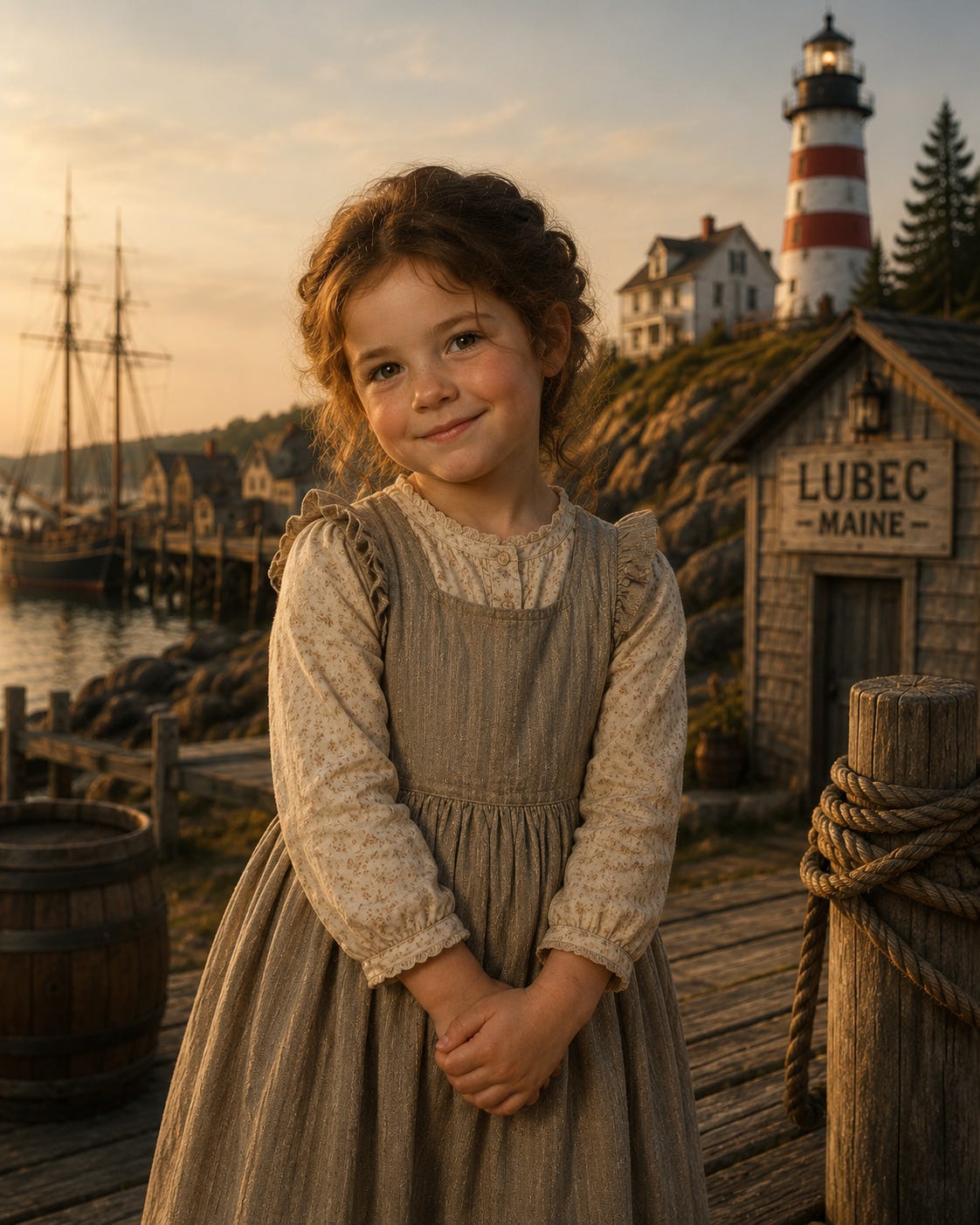
Laura held Carol Ann’s hand tightly against the wind while David stood facing the sea silently, his coat moving in the cold Atlantic air.
For a long moment Wayne simply watched his father.
And suddenly he understood something he had not fully understood before.
His father had not brought them here merely to work.
He had brought them here to build a life.
A better one.
Austin climbed down first and helped unload supplies while Wayne stood staring upward toward the towering structure above the cliffs.
The lighthouse did not feel frightening.
It felt important.
Like it belonged there.
Like somehow God Himself had placed it beside those dangerous waters.
Laura walked beside Wayne quietly.
“What are you thinking about?” she asked softly.
Wayne looked toward the sea.
Then toward the lighthouse again.
Finally he answered:
“I think this place feels bigger than Boston.”
Laura smiled gently.
“Yes son,” she said.
“I think maybe it is.”
The wind moved through the tall grass around them while evening settled slowly over Quoddy Head.
Far below, waves rolled endlessly against the rocks.
And high above the restless Atlantic waters…
the new lighthouse stood silently in the gathering dusk.
For a few quiet moments, nobody spoke.
Wayne stood near the wagon with the salt wind pushing through his hair while Carol Ann held tightly to Laura’s hand, staring wide-eyed at the enormous tower above them.
Even Austin had gone strangely quiet.
David slowly stepped beside Laura and slipped one arm around her shoulders. She leaned against him immediately, weary from the long journey but smiling all the same.
For a moment they simply stood there together facing the sea.
Then David bent down and kissed the top of her head gently.
Laura closed her eyes briefly and rested against him while the ocean wind moved through their coats.
Below them, the Atlantic crashed endlessly against the cliffs.
Ahead of them stood the lighthouse.
New.
Bright.
Inviting.
And somehow, standing there together with their children near the edge of the darkening world, both of them felt the same thing at once:
Their old life was behind them now.
Boston suddenly felt very far away.
The noise.
The crowded streets.
The endless rush.
The hard men near the docks.
All of it seemed smaller somehow compared to the vast ocean now stretching before them.
Wayne stepped closer to his father, unable to stop staring upward.
“Do you really get to light it?” he asked quietly.
David looked toward the dark lantern room high above them.
“Yes,” he answered softly.
“For the very first time.”
Wayne grinned slowly.
Not the loud grin of mischief this time.
Something quieter.
Something full of wonder.
Carol Ann tugged Laura’s sleeve excitedly.
“Will ships see it all the way out there?” she asked, pointing toward the endless water.
“They will,” Laura answered softly.
Austin stood with his hands shoved into his coat pockets, looking out across the cliffs.
“It almost doesn’t feel real,” he admitted.
David looked at his family beside him.
The people he loved most in this world.
Then he turned once more toward the sea.
The cold Atlantic wind pressed against his face while gulls wheeled high overhead crying into the fading sky.
And standing there near the edge of America itself…
with his wife beside him,
his children near him,
and the lighthouse towering silently above the cliffs…
David Hale finally felt something he had not felt in many years.
Peace.
And above them, overlooking the dark Atlantic waters…
the lighthouse still waited patiently for its first light.
Episode Two COMING SOON!
❤️ DEDICATION
I dedicate Tales from Lubec to my dear parents, Wayne and Elizabeth Porter.
My father was born and raised in Lubec, Maine, and for generations our family roots have stretched across Lubec and nearby Campobello Island. Growing up, my parents faithfully brought me there each summer, and those rugged shores, foggy mornings, fishing docks, lighthouse cliffs, and quiet coastal roads became forever woven into my heart. In recent years, while my father battled cancer, I had the privilege of taking him back many times to revisit the land he loved so deeply. Those journeys became precious to me beyond words. This series was born from those memories, those stories, those family roots, and the deep love of a place that never truly leaves you once it becomes part of your soul. Lubec was never merely a setting to us.
It was home.
Steve Porter
⚓ Join The World of Tales from Lubec 🌊
If you enjoyed Episode One, I would love to invite you to join our Facebook community, Tales from Lubec.
Join here:
Inside the group, I’ll be sharing:
🎉 New Episodes
🕯️ Character reveals
🗺️ Historical insights about Lubec and coastal life in 1808
🎬 Live videos and behind-the-scenes discussions
📜 Hidden meanings and deeper themes within each episode
🎨 Artwork, future previews, maps, lore, and much more
The journey begins…
and many more stories wait beyond the shoreline.
Steve Porter
Thank you for Tales From Lubec..The news yesterday said CBS radio will end today. When I heard the first series...I thought now..Tales of Lubec begins to give people Radio stories again. Thank you Pastor Porter.
I loved the first episode. Looking forward to the next one !